
Table of Contents
Rabid (1977): A Horror Host’s Guided Tour Into Cronenberg’s Viral Nightmare
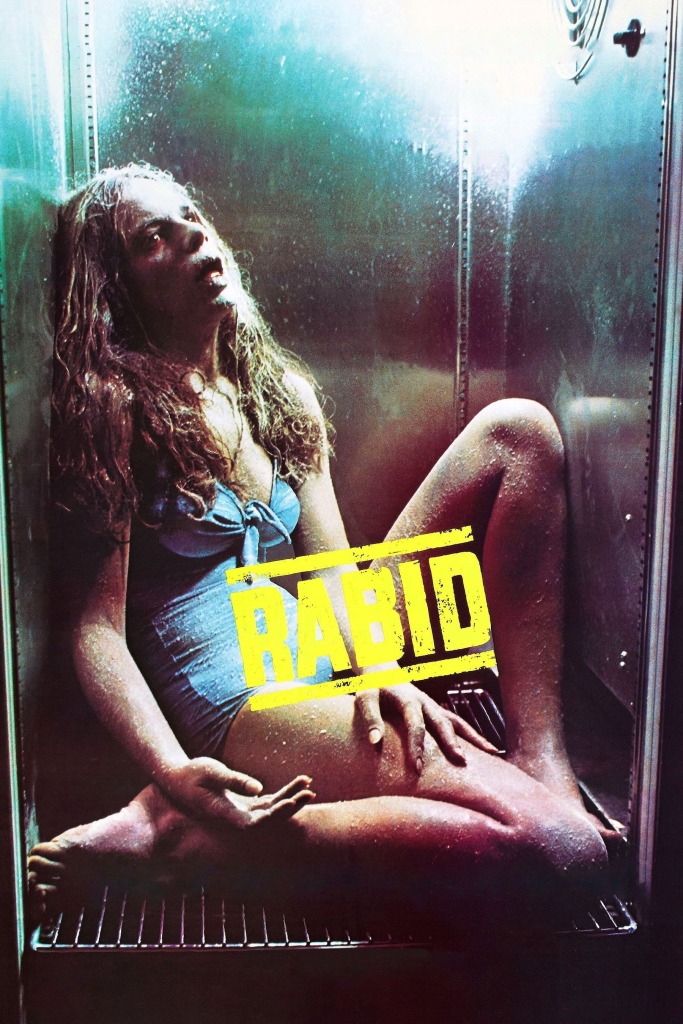
Step into the shadows, late-night fiends, and don’t forget to keep a safe distance—because tonight’s feature isn’t just scary, it’s contagious. Rabid (1977), directed by Canadian maestro of body horror David Cronenberg, slinks onto the screen like a fever dream of flesh, surgery, and urban collapse.
This is the film that helped cement Cronenberg as the mad surgeon of horror cinema, dissecting not just bodies, but society itself.
In an era when horror was mutating into stranger, more visceral forms, Rabid stood out as a cold, clinical nightmare: a woman transformed by experimental surgery, a parasitic stinger hidden in her armpit, and a city slowly devoured by a rabies-like epidemic. It doesn’t just bite—it spreads.
The Story: Blood Hunger and Montreal in Panic
Rabid follows Rose, a young woman gravely injured in a motorcycle accident near a secluded plastic surgery facility, the Keloid Clinic.

To save her life, the clinic’s doctors perform an experimental grafting procedure.
Rose survives—but something new has awakened inside her. From a strange opening under her arm emerges a retractable, blood-sucking organ, a parasitic stinger that turns her into a vector of infection.

Rose’s victims don’t simply die; they become violently rabid, attacking others and spreading a mysterious disease across Montreal. Cronenberg uses this outbreak to explore themes of medical ethics, bodily autonomy, and the fragility of social order.

The film builds on ideas he first explored in Shivers, but pushes deeper into the horror of the flesh, making the body itself the battleground.
Watch the Trailer
Release Dates, Release Information, and Box Office
Country of origin: Canada
Director: David Cronenberg
Runtime: Approximately 91 minutes
Rating: R (violence, gore, nudity)
Release dates:
Canada: April 8, 1977
United States: July 6, 1977

Rabid was produced on a modest budget (reported around CA$530,000–$550,000) and distributed by Cinépix in Canada and New World Pictures in the United States. Despite its relatively low cost, the film was a commercial success, earning several million dollars worldwide and helping to establish Canadian genre cinema as a viable export.

Reception on Release
Upon release, Rabid received a mix of fascination and discomfort from critics. Some reviewers found the narrative repetitive or overly bleak, but many were struck by Cronenberg’s clinical style and the unsettling plausibility of the outbreak scenario.

The casting of Marilyn Chambers, known primarily for her work in adult films, drew significant attention and controversy, but her performance was often praised as surprisingly effective and emotionally grounded.

The film’s graphic violence and disturbing medical imagery made it a lightning rod for criticism, especially among more conservative commentators, yet it also attracted a cult audience that appreciated its uncompromising vision.
Reception Today
In modern retrospectives, Rabid is widely regarded as a key early work in Cronenberg’s filmography and a foundational entry in the body horror subgenre. Contemporary critics highlight its prescient depiction of viral panic, its cold, procedural tone, and its exploration of how institutions respond—or fail to respond—to crisis.

The film now enjoys generally positive critical standing, often cited alongside Shivers, The Brood, Videodrome 🎬 🛍️, and The Fly as part of Cronenberg’s essential horror canon. What once seemed exploitative or extreme is now recognized as thematically rich and eerily relevant.
Cast, Characters, Careers, and Where They Went
Marilyn Chambers as Rose
Marilyn Chambers plays Rose, the tragic center of the film—a woman transformed into a carrier of infection. Her casting was controversial due to her fame in adult cinema, but it gave Rabid a unique edge and marketing hook. The role showcased her ability to carry a mainstream genre film, and it remains her most famous non-adult performance.
After Rabid, Chambers continued working in both adult and mainstream projects, including occasional film and television appearances. She became a cult figure in horror circles, with Rabid often cited as proof of her crossover potential.
Frank Moore as Hart Read
Frank Moore portrays Hart Read, Rose’s boyfriend, who becomes increasingly desperate to find and help her as the outbreak spirals out of control. Moore’s performance adds emotional weight to the film, grounding the chaos in a personal struggle.
Moore went on to work steadily in Canadian film, television, and theatre, building a long career as a character actor.
Joe Silver as Murray Cypher
Joe Silver appears as Murray Cypher, a friend of Hart and part of the film’s network of characters caught in the spreading disaster. Silver was a familiar presence in Canadian cinema and television, often cast in supporting roles.
He continued acting until his death in 1989, leaving behind a body of work that includes multiple genre and dramatic projects.
Howard Ryshpan as Dr. Dan Keloid
Howard Ryshpan plays Dr. Dan Keloid, the head of the clinic whose experimental procedure saves Rose’s life but unleashes the infection. His character embodies the film’s critique of medical hubris and the unintended consequences of innovation.
Ryshpan remained active in acting and voice work, contributing to Canadian theatre, film, and television over many years.
Terri Hanauer as Judy Glasberg
Terri Hanauer appears as Judy Glasberg, one of the characters swept up in the outbreak. Her role adds to the sense of everyday lives being disrupted by the spreading horror.
Hanauer later transitioned into directing and photography, building a career behind the camera and in visual arts.
Patricia Gage as Dr. Roxanne Keloid
Patricia Gage plays Dr. Roxanne Keloid, another key figure at the clinic. Her presence reinforces the film’s focus on medical professionals caught between ethics, experimentation, and catastrophe.
Gage continued acting in film and television until her passing in 2010, appearing in numerous Canadian and international productions.
Susan Roman as Mindy Kent
Susan Roman plays Mindy Kent, one of the supporting characters affected by the outbreak. While her on-screen role here is relatively small, Roman’s career would grow significantly in another arena: voice acting.
She became a prolific voice actress, known for work on animated series including the English dub of Sailor Moon
and many other projects.
Susan Roman on Wikipedia
Roger Periard as Lloyd Walsh
Roger Periard appears as Lloyd Walsh, another figure in the web of characters touched by Rose’s condition and the spreading disease. His role contributes to the film’s sense of a city-wide crisis.
Periard continued working in Canadian film and television, though he does not have a dedicated Wikipedia biography.
Behind the Scenes, Easter Eggs, On-Set Stories, and Filming Locations
Filming Locations
Principal photography for Rabid took place in and around Montreal, Quebec, Canada. Cronenberg used real urban locations to emphasize the outbreak’s spread through everyday spaces—streets, shopping centers, public transit—rather than isolated, gothic settings. This choice gives the film a grounded, almost documentary feel as the city descends into chaos.
Easter Eggs and On-Set Details
One of the film’s sly touches is the naming of the clinic’s doctors “Keloid.” A keloid is a type of raised scar tissue, making the name a dark medical joke that fits perfectly with Cronenberg’s fascination with the body and its imperfections.
The project reportedly had the working title Mosquitoes, reflecting Cronenberg’s interest in parasitic organisms and blood-feeding creatures. While the title changed to Rabid, the parasitic concept remained central to the story and design of Rose’s condition.
Cronenberg originally wanted Sissy Spacek for the role of Rose, but producers rejected her due to concerns about her accent and appearance. In a bit of cinematic irony, a poster for Carrie—Spacek’s breakout horror film—appears in a street scene, functioning as a subtle nod to what might have been.
Makeup and practical effects were crucial to the film’s impact. The infamous armpit stinger and the rabid victims’ symptoms were created with practical makeup techniques, giving the film a tactile, unsettling realism that digital effects often struggle to match.
The film’s funding was somewhat controversial. The Canadian Film Development Corporation helped finance Rabid, but faced criticism for supporting Cronenberg’s earlier film Shivers. This tension between public funding and transgressive horror made Rabid part of a larger conversation about what kinds of art should receive institutional support.
Overall Effect on the Horror Genre
Rabid is a cornerstone of body horror, a subgenre that focuses on the corruption, transformation, and vulnerability of the human body. Cronenberg’s clinical approach, his interest in medical experimentation, and his refusal to separate physical horror from social commentary helped shape the direction of horror cinema in the late 20th century.
The film’s depiction of a viral outbreak spreading through a modern city influenced later infection and outbreak narratives, from zombie films to pandemic thrillers. Its emphasis on institutional failure, public panic, and the thin line between treatment and harm resonates strongly with contemporary audiences.
For Cronenberg, Rabid was an important step toward the more elaborate and philosophically dense works that would follow. For horror as a whole, it proved that low-budget, high-concept films could explore complex ideas while still delivering visceral shocks.
Final Thoughts
Rabid is an infection that seeps under the skin and lingers in the mind. With its blend of medical horror, urban paranoia, and tragic character study, it remains one of David Cronenberg’s most important early works and a vital chapter in the evolution of horror cinema.
So if you queue it up for a midnight viewing, remember: in Cronenberg’s world, you can’t always trust your body, your doctors, or your neighbors.
One moment they’re perfectly normal… and the next— well, that’s what the movie is for.
Where to Buy & Stream
Sources
Related Products on Amazon:

We may earn a small commission from purchases made through these links.



Leave a Reply