
In the annals of horror cinema, few films have managed to inject such raw, visceral terror and desperate survival into the undead narrative quite like Danny Boyle’s 2002 masterpiece, “28 Days Later.” Forget slow, shuffling corpses; this film unleashed a new breed of infected – fast, ferocious, and fueled by pure, unadulterated rage. It was a stark and brutal reimagining that left audiences breathless and redefined what a “zombie movie” could be.
Table of Contents
Introduction
Set against the desolate backdrop of a deserted Britain, “28 Days Later” thrusts us into a world where civilization has crumbled in the blink of an eye. The film isn’t just about jump scares; it’s a chilling exploration of humanity pushed to its absolute limits, the fragile nature of society, and the primal instincts that surface when all else is lost. Prepare to be plunged into a nightmare that still haunts us to this day.
Plot Synopsis
28 Days Later opens with a chilling image: a group of animal rights activists attempting to break into a research laboratory in Oxford. Their mission is to free caged chimpanzees, but in their haste, they unleash a highly contagious virus – codenamed “Rage” – which causes immediate and irreversible aggression, turning its victims into hyper-violent, flesh-devouring monsters. The infection spreads like wildfire, decimating the population and leaving the UK in ruins.

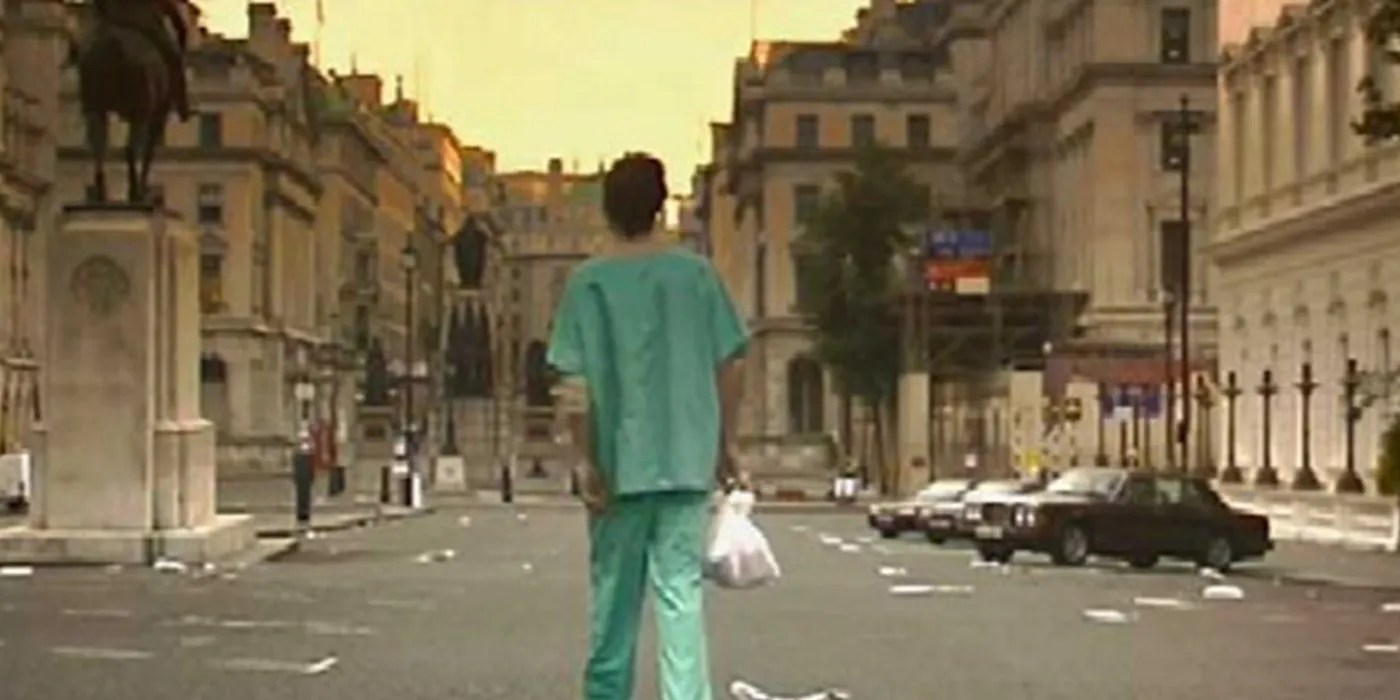
Twenty-eight days later, we are introduced to Jim, a young man who awakens from a coma in a deserted hospital. He finds himself utterly alone in a silent, eerily empty London, the city transformed into a ghost town littered with the remnants of a fallen society. Driven by confusion and a desperate need to find survivors, Jim ventures out into the desolate streets, soon encountering the horrifying reality of the “infected.” His initial solitary struggle for survival takes a turn when he meets Selena, a hardened and pragmatic survivor, and later, Frank and his daughter Hannah.

Together, they embark on a perilous journey through the ravaged landscape, seeking refuge and a glimmer of hope. Their path is fraught with danger, not only from the relentless infected but also from other, equally desperate and potentially more dangerous, human survivors. The group eventually finds a supposed military safe haven at a fortified manor, only to discover that the promised salvation might be an even greater threat than the virus itself.

Cast and Characters
- Cillian Murphy as Jim
- Naomie Harris as Selena
- Daniel Brocklebank as a Scientist (opening scene)
- Christopher Dunne as a Taxi Driver (opening scene)
- Noah Huntley as Mark
- Alexandra Maria Lara as a Woman in the Car
- Megan Burns as Hannah
- Peter Mullan as Sergeant Major Henry West
- David Schneider as a Man in the Supermarket
- Jodie Whittaker as a Nurse
Release Date and Details
- Original Release Date: November 1, 2002 (United Kingdom)
- Director: Danny Boyle
- Screenplay: Alex Garland
- Genre: Horror, Sci-Fi, Thriller
- Running Time: 113 minutes
- Distributor: Fox Searchlight Pictures
Where to watch





Little-Known Production Facts and Behind-the-Scenes Details for 28 Days Later (2002)
1. The empty London scenes were filmed at dawn with minimal permits
The iconic shots of deserted London were achieved by closing small sections of the city for only a few minutes at a time. Filming took place at dawn on weekends, and production assistants stopped traffic briefly while the crew captured footage. The team often had less than one minute to get each shot before reopening the streets.
2. The film was shot almost entirely on digital video
Director Danny Boyle chose to shoot on Canon XL1 digital cameras, which was unusual for a major feature at the time. The grainy, harsh look of early digital video helped create the film’s documentary-style realism and contributed to its unsettling atmosphere.
3. The “rage virus” was inspired by real-world research
The opening sequence showing chimpanzees exposed to violent imagery was influenced by studies on the psychological effects of aggression and media. Boyle and writer Alex Garland wanted a virus that felt grounded in reality rather than supernatural, leading to the concept of a fast-spreading, behavior-altering infection.
4. The infected were portrayed by athletes and dancers
To achieve the unnatural, jerky movement of the infected, the production hired trained athletes, dancers, and performers with strong physical control. Their movements were choreographed to feel fast, unpredictable, and animalistic, setting the film apart from traditional zombie portrayals.
5. The hospital scene was filmed in a real, abandoned ward
Cillian Murphy’s early scenes were shot in an unused section of a London hospital scheduled for renovation. The production used minimal dressing, relying on the natural decay and emptiness of the location to enhance the sense of isolation.
6. The film’s alternate endings were shot due to studio concerns
Several alternate endings were filmed, including one where Jim dies and another where the entire third act is reimagined without the military compound. These were created after test screenings and studio requests, though Boyle has stated that the theatrical ending remains his preferred version.
7. The military blockade scenes were shot at an active location
The roadblock sequence was filmed on a real motorway that allowed the crew limited access during off-hours. The production had to work quickly and coordinate closely with authorities to avoid disrupting traffic.
8. The film’s soundtrack was built around tension rather than melody
Composer John Murphy created a score that relied heavily on building layers of sound, distortion, and repetition. The track “In the House, In a Heartbeat” became one of the most recognizable pieces of music in modern horror, designed to escalate tension rather than follow traditional musical structure.
9. The supermarket scene was improvised on location
The lighthearted supermarket sequence was filmed in a real store that allowed the crew to shoot after hours. Much of the dialogue and action was improvised, giving the scene a natural contrast to the film’s darker moments.
10. 28 Days Later production used practical effects for most infected encounters
Rather than relying on CGI, the film used makeup, prosthetics, and practical blood effects to portray the infected. This grounded approach helped maintain the gritty realism that defines the film’s visual style.
Conclusion
“28 Days Later” is more than just a horror film; it’s a potent social commentary wrapped in a terrifying package. Its influence is undeniable, inspiring a wave of “fast zombie” films and proving that even a well-worn genre can be revitalized with a fresh, relentless vision. The film’s bleak atmosphere, unflinching brutality, and moments of profound human connection make it an enduring classic that continues to shock and provoke thought. If you haven’t experienced the rage, you owe it to yourself to dive into this chilling masterpiece.